Jung von Matt for Pro Infirmis – Who is perfect, anyway?
Posted: December 6, 2013 Filed under: Ambient, Event, Installation, Switzerland, Testimonial | Tags: Alain Gsponer, Alex Oberholzer, Ambient, Because who is perfect?, disabled people, installation, Jung von Matt, mannequin, Pro Infirmis 1 Comment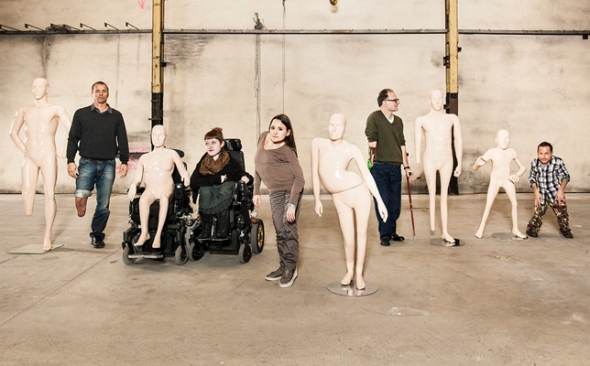
A Swiss charity has created mannequins based on the bodies of disabled people in a bid to raise awareness that no one has a perfect body. Pro Infirmis, an organisation for people with disabilities, worked with people suffering from scoliosis (a curved spine), shortened limbs and a woman in a wheelchair. Each had a mannequin made to perfectly reflect their body shape – which, to their delight, was then displayed in a high street store in Zurich’s main shopping street.


The project was devised to mark the International Day of Persons with Disabilities this week. Called ‘Because who is perfect? Get closer’, the story is captured in a moving four-minute film directed by Alain Gsponer. The film follows four volunteers who enter a warehouse with trepidation. The models are radio host and film critic Alex Oberholzer, Miss Handicap 2010 Jasmine Rechsteiner, athlete Urs Kolly, actor Erwin Aljukić and blogger Nadja Schmid. The film captures the emotional moment each person sees their unique sculpture – and reveals the internal struggle some of those involved have accepting their appearance. Viewers then see the mannequins carefully dressed and placed in the front window in a shop on Bahnhofstrasse, Zurich’s main downtown street. Dave Thomas Junior contributed the music for the new work. The piece Lost at Sea was newly arranged specially for the Pro Infirmis film.
One model said: “Seeing it there for real is quite a shock. This, says the charity Pro Infirmis, is the point of the campaign. It hopes to raise awareness of people with disabilities, specifically in the image-obsessed worlds of fashion and retail. Upon seeing her mannequin, one woman declares: ‘It’s special to see yourself like this, when you usually can’t look at yourself in the mirror”.


Advertising Agency: Jung von Matt/Limmat, Zurich, Switzerland
Executive Creative Director: Alexander Jaggy
Art Director: Daniel Serrano
Copywriter: Samuel Wicki, Mateo Sacchetti
Graphic Designer: Lukas Frischknecht
Year: 2013
British Airways – Plane Detecting Billboards
Posted: November 21, 2013 Filed under: Ambient, Digital, Installation, UK | Tags: Ambient, British Airways, France, installation, Outdoor, plane, Plane Detecting Billboards 2 Comments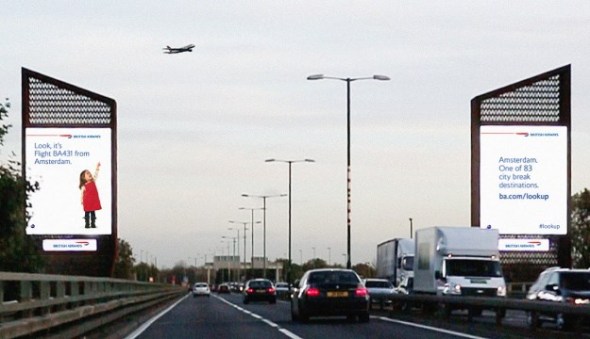
British Airways has unveiled digital billboards which will ‘interact’ with aircrafts flying overhead, as the brand looks to remind customers how magical flying can be, from the perspective of children. Developed by Ogilvy 12th Floor, the ads use custom built surveillance technology which tracks the aircraft and interrupts the digital display just as it passes over the site, revealing the image of a child pointing at the plane overhead accompanied by its flight number and destination it’s arriving from. This will be accompanied by a relevant message to the flight, such as ‘Fly the new A380 to Los Angeles. ba.com/lookup’, or details such as the lowest fare available or the temperature at the destination.
Abigail Comber, British Airways’ head of marketing, said: “This is a first, not just for British Airways but for UK advertising. We all know from conversations with friends and family that we wonder where the planes are going and dream of an amazing holiday or warm destination. The clever technology allows this advert to engage people there and then and answer that question for them. We hope it will create a real ‘wow’ and people will be reminded how amazing flying is and how accessible the world can be.”
The destinations can also be updated immediately depending on changing focus routes for the airline. The ads are part of the airlines’ “Magic of Flying” campaign, which aims to remind people of how magical flying can be, especially from the eyes of a child. The “interactive” billboards are located in London’s Piccadilly Circus and Chiswick.
Ceres Beer – #ivoteanyway (How a beer did what the government could not do)
Posted: May 6, 2013 Filed under: Alcoholic Drinks, Ambient, Case History, Event, Italy, Low Budget | Tags: Ambient, Bcube, Case History, ceres beer, ivoteanyway Leave a commentI’m an Executive Creative Director. And if you ask people who work with me, they’ll tell you that when it comes to judging our own works, I’m always hypercritical. That’s why I’ve never posted here any campaign coming from my agency.
But today I’m pretty proud of this project, so I decided to share it. Hope you’ll like it like I do.

Election time is near and Italian politicians, the most aged in Europe, never miss an opportunity to show their distance from young people and their needs. For a bureaucratic obstacle, thousands of students who live outside the country (e.g. for the Erasmus program) will not be able to vote from abroad. Despite the calls of the European Union and the students’ protest, no one can solve the problem. Ceres, one of the most popular beers in Italy, decides to prove that these guys are better than those who represent them in parliament.
Our goals were to boost the brand awareness becoming the main supporters of the movement and to bring the problem to the attention of everyone, inspiring the conversation about the right to vote and the sense of responsibility of young Italians. We knew that it would have also improved the reputation of Ceres, a beer with a high alcohol content: we wanted to show everyone that the guys who love Ceres are responsible and mature people, that care for themselves and for their country’s future.
Ceres is a strong beer. It believes it’s always worth to take a position, to stand, even if it means making difficult or inconvenient choices. Even if maybe you won’t win. This is the essence of the brand, it is called “Inglorious Heroism”, and it is summed up by the pay-off “The town needs heroes.” Students in Erasmus are real heroes in the midst of their quest to discover the world. These young heroes had been wronged and Ceres decided to help them to vote anyway. Italy is an old, tired country that needs the energy of young people. As the slogan of this operation says, “Italy needs of Heroes.”

We contacted representatives of the students in major European cities. We told them we wanted to organize symbolic elections to make them vote anyway. We launched the twitter hash tag #iovotolostesso (#ivoteanyway), we sent groups in each city a kit with everything they needed to run and publicize the symbolic elections: facsimile ballots, ballot boxes, flyers and posters. We also sent them a few packs of beer to celebrate at the end. The kit also contained instructions on how to create video appeals that students would send us and would become part of a collective promo video. The video was posted on the web, the students used it to spread the word and we sent it to mainstream media.
More groups spontaneously joined in. The symbolic elections took place in 26 European cities on the same days of the Italian real elections. We sent the symbolic results to the media a few hours before the close of official polling stations.

Results:
For the cause:
Thousands of students from 26 European cities joined the initiative. The protest achieved unprecedented visibility on all the national media: TV, newspapers magazines, radios, social media, news website and blogs. The operation opened a debate all around the country. #ivoteanyway became a tweet trend with more than 10.000 tweets in 10 days.
For the brand:
Brand search frequency on google: +470% in 10 days. Ceres was the most cited brand during the election week. People reached: 20 millions, one third of the italian population. Media investment: less than € 5,000.
Advertising Agency: Bcube, Milan
Executive Creative Director: Francesco Bozza
Creative Director: Sergio Spaccavento, Andrea Stanich
Creative Team: Sergio Spaccavento, Andrea Stanch, Alessandro Sciarpelletti, Silvia Savoia
Edit: Danilo Carlani, Alessio Dogana
Year: 2013
From Coke to Mikado – Don’t Underestimate the Power of a Red Button
Posted: March 13, 2013 Filed under: Ambient, Australia, Awards, Belgium, Beverages, Brazil, Cannes Lions, Case History, Cliché, Direct, Event, France, Installation, Press/Outdoor, Promotion, TV/Film, USA, Viral | Tags: Ambient, Belgium, Buzzman, Cannes Lions, Case History, Clemenger BBDO, Coca-Cola, Duval Guillaume, fantastic delites, France, funny, Happiness Truck, installation, Mikado, push the red button, push to add drama, resistence test, TNT Tv Channel, USA, Viral Leave a comment
Mikado – Resistance Test
Advertising Agency: Buzzman, Paris, France
CEO / Creative Director: Georges Mohammed-Chérif
Art Director: Louis Audard
Copywriter: Tristan Daltroff
Art Director Assistant: Clément Séchet
Year: 2013
TNT TV Channel – Dramatic surprise on an ice-cold day
Advertising Agency: Duval Guillaume Modem, Brussels
Creative Director: Geoffrey Hantson, Katrien Bottez
Copywriter: Dieter De Ridder
Art Director: Ad Van Ongeval
Production Company: Czar
Director: Koen Mortier
Year: 2013
Fantastic Delites – How Far Would You Go?
The Delite-o-matic is an interactive vending machine that dispenses free packs of Fantastic Delites simply by pushing a button hundreds of times or by performing challenges. The Delite-o-matic was put out on the streets to prove that because Fantastic Delites taste so good, people will go to incredible lengths to get their hands on them.
Advertising Agency: Clemenger BBDO, Australia
Creative Director: Karl Fleet
Digital Creative / Art Director: Oliver Prenton
Digital Creative / Copywriter: Matt O’Grady
Year: 2012
TNT TV Channel – Big Red Push Button
To launch the high quality TV channel TNT in Belgium we placed a big red push button on an average Flemish square of an average Flemish town. A sign with the text “Push to add drama” invited people to use the button.
Advertising Agency: Duval Guillaume Modem, Brussels
Creative Director: Geoffrey Hantson, Katrien Bottez
Copywriter: Dieter De Ridder
Art Director: Ad Van Ongeval
Production Company: Czar
Director: Koen Mortier
Year: 2012
Coca-Cola – Happiness Truck
A Coca-Cola delivery truck is converted into a happiness machine on wheels delivering “doses” of happiness in the streets of Rio De Janeiro, Brazil. Where will happiness strike next?
Advertising Agency: Definition 6, Atlanta
Year: 2011
Welcome to ROACHVILLE from TBWA Johannesburg
Posted: February 8, 2013 Filed under: Ambient, Case History, Guerilla, Installation, Press/Outdoor, South Africa | Tags: Adam Livesey, Ambient, Case History, cockroaches, doom fogger, funny, installation, Matthew Bring, TBWA, TBWA/Hunt/Lascaris, welcome to roachville Leave a comment


TBWA Hunt Lascaris Johannesburg’s brief was to conceptualise an outdoor campaign that illustrates that Doom Fogger gets into every nook and cranny, killing insects before they get too comfortable. Using cracks on outdoor walls, they created a make-believe world, showing cockroaches in different environments. This was achieved by creating miniature furniture and using actual cockroaches to depict real life scenarios inside the cracks.
Advertising Agency: TBWA, South Africa
Executive Creative Directors: Matthew Bring, Adam Livesey
Creative Director: Justin Wright
Art Director: Sifiso Nkabinde
Copywriter: Thokozani Mashigo
Agency Producer: Sharon Cvetkovski
Account Manager: Vanessa Maselwa.
Production: Birthmark
Director of photography: Rowan Cloete
Producer: Matthew Durant
Year: 2012
TBWA/Berlin for adidas – A Giant Case History
Posted: December 28, 2012 Filed under: Agency, Ambient, Awards, Cannes Lions, Case History, Event, Germany, Guerilla, Installation, Press/Outdoor, Sportwear | Tags: adidas, Ambient, Boris Schwiedrzik, Cologne Central Station, Emiliano Treierveiler, Erik Gonan, football fresco, Germany, Guerilla, Helge Bloch, Hendrik Scweder, impossible goalkeeper, impossible huddle, Impossible is nothing, Kurt-Georg Dieckert, Marco Bezerra, Oliver Kahn Bridge, Outdoor, Petr Cech, Prater ferris wheel, Stefan Schmidt, TBWA, UEFA, Zurich's Central Station Leave a commentIMPOSSIBLE GOALKEEPER

Just before the start of the UEFA Euro 2008 football tournament, adidas turned one of Vienna’s best-known landmarks, the Prater ferris wheel, into a huge image of the Czech national goalkeeper, Petr Cech. At a whooping 53m tall, this gigantic installation was visible far beyond the Prater entertainment park and the nearby public viewing sites. In the installation, Cech had eight arms that constantly rotated with the ferries wheel. The erection of the metal construction started on May 13 and was finished just before the launch of the tournament on the night of June 5, 2008. This advertising landmark also hosted the official adidas press conference prior to the tournament.

Advertising Agency: TBWA/Berlin
Creative Director: Stefan Schmidt
Creative: Marco Bezerra, Emiliano Treierveiler
————————————————————————————————————————————————————————————
OLIVER KAHN BRIDGE

If you travelled to Munich for the first game of the FIFA World Cup in 2006, chances are you saw this huge installation, which shows an enormous Oliver Kahn (the then German national team goalkeeper) diving across the motorway. The 65-m installation managed to bypass the law forbidding advertising on the German Autobahn, and was the only piece of advertising adidas conducted in Germany during the tournament. Over 4 millions people commuted through the installation and many more saw it in the press. In its first week the Oliver Kahn bridge was displayed on double-page spreads in leading magazines including Focus, Stern, Autobild and Fortune. It was also picked up by newspapers including the New York Times and the Financial Times.


Advertising Agency: TBWA/Berlin
Creative Director: Stefan Schmidt, Kurt-Georg Dieckert
Creative: Helge Bloch, Boris Schwiedrzik
————————————————————————————————————————————————————————————
IMPOSSIBLE HUDDLE

For the duration of the UEFA EURO 2008 football tournament, TBWA/Berlin transformed the main hall of Zurich’s Central Station into a large-scale celebration of team spirit. Eleven European football players (all sponsored by adidas, naturally) formed the Impossible huddle. The bodies of the footballers represented were 3D-scanned as were their faces and hairstyles, to ensure that the sculptures were faithful to the originals. It took 40 trucks to move the installation components from the production sites in southern Germany to Switzerland, where they were assembled in the station.

The Swiss rail authority reported that an estimate 13 million people passed through the station during the three-week period the sculptural installation was in site, and at 17m high and approximately 30m wide, it was impossible to miss. Add to this the fact that various news titles such as the Financial Times, Die Welt, Gazzetta dello Sport, Le Parisien and the BBC featured the campaign on their front pages or online editions, plus the fact that it was picked up by dozens of blog worldwide.


Advertising Agency: TBWA/Berlin
Creative Director: Stefan Schmidt, Markus Ewertz
Creative: Erik Gonan, Hendrik Scweder
————————————————————————————————————————————————————————————
FOOTBALL FRESCO

During the German-hosted 2006 FIFA World Cup, adidas wanted to get across the message that they cooperate with the best football players on the planet. Rather than run a traditional poster campaign, the creatives at TBWA/Berlin decided it would be far more impressive to create a huge Renaissance-style fresco on the ceiling of the main lobby of Cologne Central Station. Within minutes of the fresco’s unveiling, it was featured on national German Television and press covered it throughout the World Cup. More than 8.5 million people saw the frersco in the flesh during the course of the tournament.


Advertising Agency: TBWA/Berlin
Creative Director: Stefan Schmidt, Kurt-Georg Dieckert
Creative: Helge Bloch, Boris Schwiedrzik
Monopoly in advertising
Posted: December 11, 2012 Filed under: Ambient, Awards, Chile, Cliché, Germany, Guerilla, Installation, Portugal, Press/Outdoor, Singapore, Spain, USA | Tags: a real game, advertising, Ambient, DDB Spain, Donald Trump, funny, Germany, Grey Chile, Guerilla, JWT, Monopoly, Own it all, Paris Hilton, TBWA Leave a comment
Monopoly – New York/London/Madrid


Advertising Agency: DDB Spain
Year: 2005
Monopoly – “Own it all” Campaign


Advertising Agency: JWT Frankfurt
Year: 2009
Monopoly – A Real Game


Advertising Agency: DDB Madrid
Year: 2008
Monopoly – Mansion/Jail


Advertising Agency: Grey Chile
Year: 2007
Monopoly – Be careful where you land


Advertising Agency: TBWA Singapore
Year: 2007
Monopoly – Building Branding


Advertising Agency: DDB Lisboa
Year: 2006
Monopoly – Barcelona Edition/New York Edition


Advertising Agency: DDB Madrid
Year: 2006
Monopoly – Before/After Campaign


Advertising Agency: Grey Chile
Year: 2006
Monopoly – The Here & Now Edition


Advertising Agency: Grey New York
Year: 2009
Monopoly – “Be a Player” Campaign


Student project by Alexandra George and Candice Countryman.
Year: 2011
Monopoly – Ambient

Student project by Miami Ad School, Madrid
Year: 2010
Leo Burnett for Think!/Road Safety Campaign – Man Trapped in Pint Glass
Posted: December 6, 2012 Filed under: Ambient, Awards, Case History, Installation, Social, UK | Tags: Ambient, Bertie Scrase, Guy Moore, installation, Leo Burnett, Man trapped in pint glass, Paddington Station, Phillip Deacon, Road safety campaign, Think!, Tony Malcom Leave a comment
Agency Leo Burnett did some research and found that anti-drink-driving advertising based around crashing and injury was no longer likely to effect the target demographic of young male drivers who don’t believe that driving after drinking a couple of beers is dangerous. The agency found that low-consumption male drink-drivers were more likely to be deterred by personal consequences of a drink-driving conviction.
The idea of this campaign was to play against the seasonal jollity of the Christmas period and to dramatize the experience of isolation, regret and stigmatization brought about by a drink-driving conviction. In December 2007 a real-life convicted drink-driver agreed to be placed inside a specially constructed upturned pint glass. He was thus trapped by his seemingly innocuous decision to get behind the wheel after having one pint too many. The subject was interviewed by national press and broadcast media in Paddington Station as he explained how being convicted of a drink-driving offence had ruined his life: he had lost his job, his girlfriend, his car and a lot of money. An actor then took over the role of the drink-driver up and down the country at locations specially chosen for their proximity to public car parks and areas with a high concentration of pubs and bars (particulary those used by football fans).

The campaign is thought to have contributed to a drop of 20% in breath test failures during the pre-Christmas period of 2007.
Advertising Agency: Leo Burnett London
Creative Directors: Tony Malcom, Guy Moore
Creatives: Phillip Deacon, Bertie Scrase
Year: 2007
Scholz & Friends for Fresh’N’Friends – Fruit Figures
Posted: November 30, 2012 Filed under: Ambient, Case History, Design, Digital, Direct, Event, Germany, Graphic Design, Installation, Promotion | Tags: Alexander Doepel, Ambient, Bjoern Kernspeckt, Case History, Direct, Florian Schwalme, Fresh`N´Friends, Fruit Figures, Germany, Jinhi Kim, Loic Sattler, Martin Pross, Mathias Rebmann, Matthias Spaetgens, organic supermarket, Promotion, René Gebhardt, Sandra Krebs, Scholz & Friends, Wolf Schneider Leave a comment

All adults know: healthy eating is important. The organic supermarket chain Fresh`N´Friends benefits from that situation. There is just one small problem: kids hate healthy food but they love sweets. Actually, that´s even a big problem. In Germany every fifth child is overweight. “Instead of calling attention to that problem with a traditional ad campaign we chose to solve the problem.”
The solution was a new product: fruit figures. “To make fruits as appealing as sweets for kids we designed fruit arrangements that suit children. Boring fruits were designed in shape of teddy bears, kittens, flowers – all the things kids love.” Just like ordinary fruit salads the fruit figures were sealed, put in a tray and sold in Fresh´N´Friends stores.


Additionally, they were promoted with advertising specifically targeted at parents and their kids – direct mailings, email newsletters and posters. In order to involve the kids directly in the campaign a contest was started. We placed cut-out sheets in every package. So the kids could make their own fruit figures by hand. They also could design them digitally on the Fresh`N´Friends website. All ideas were published and judged online. The figure with the most votes was added to the product range. Over 3,500 designs from children were submitted. The rabbit figure of five-year-old Dario got the most votes and was therefore added to the product range.


Advertising Agency: Scholz & Friends, Berlin, Germany
Creative Director: Martin Pross, Matthias Spaetgens, Wolf Schneider, Mathias Rebmann, Florian Schwalme
Art Director: Alexander Doepel, Sandra Krebs, Bjoern Kernspeckt, René Gebhardt, Loic Sattler, Jinhi Kim
Photographer: Attila Hartwig
Graphics: Peter Schoenherr, Simon Rossow
Year: 2012
BETC Euro RSCG for Sci Fi Channel – Adopt Sci Fi (Integrated Campaign)
Posted: October 26, 2012 Filed under: Agency, Ambient, Awards, Case History, Digital, Direct, France, Guerilla, Press/Outdoor, TV/Film | Tags: adopt sci fi, advertising, alien, Ambient, BETC Euro RSCG, Case History, Digital, France, orphanage, perdu, Promotion, Sci Fi Channel, toys, treasure hunt, TV/Film 1 Comment
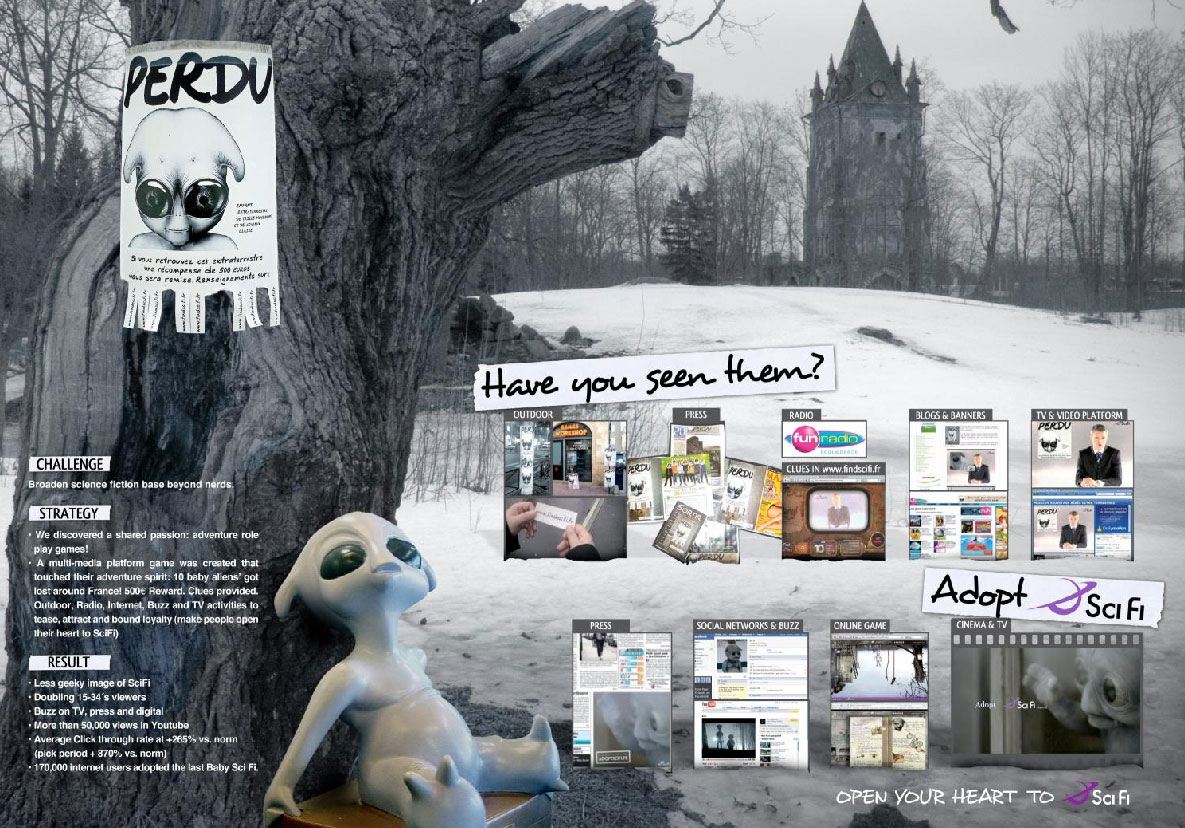

 In 2008 BETC Euro RSCG created this integrated campaign, which incorporated ambient, radio, press, film and on-line elements, to raise awareness of the Sci Fi Channel in France. The campaign was based around ten alien “children” toys that were placed in different locations acros eight French cities. Fans were then encouraged to search for them by following clues found on a website and in radio ads. Posters were also displayed around towns to advertise the website. The intention was to create an emotional link between the Brand and people who were not already fans of science fiction. Each alien found earned its rescuer a reward of 500 euros. When nine of the figures had been located it was revealed that the tenth had been placed in an orphanage, where it could be interacted with via a website and a page on Facebook.
The treasure hunt apect of the campaign appealed to fans of the Sci Fi Channel, while also attracting new viewers to the brand.

Advertising Agency: BETC Euro RSCG, Paris
Year: 2008

 This is not ADVERTISING