Leo Burnett Italy for WWF: Pets4Pets Project – Advertising thought by kids to get adults thinking
Posted: December 16, 2013 Filed under: Agency, Case History, Digital, Italy, Low Budget, Press/Outdoor, Social, TV/Film | Tags: advertising, advertising thought by kids, bear, Leo Burnett, Pets4Pets Project, TV/Film, WWF Leave a commentWhat about asking youngsters, instead of experienced creative directors, to create the strongest communication campaigns?
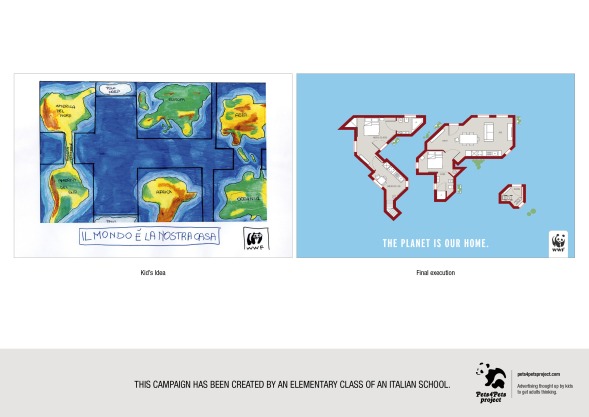
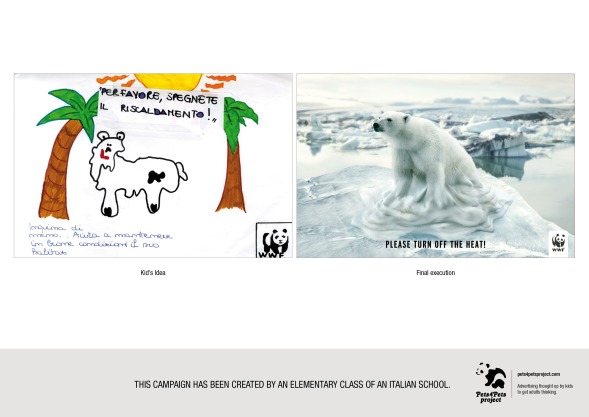
Pets4Pets Project taught little kids the secrets of the advertising industry; inviting them to imagine new social campaigns to help protect the animals they love the most. WWF, together with a team of creatives, photographers, illustrators, film directors, animators, post-producers and speakers helped students at an elementary school experience the whole creative process: from the brief, to the Pre Production Meeting, to the shooting, to going on-air. The result? Well see for yourself in the case video.

The adventure starts in the classroom, then moves inside the creative agency and finally arrives on a production set. For all the experienced creatives there’s just one strict rule: “never ‘contaminate’ the kids’ ideas”, just offer them the production advice they lack. First Challenge: a print campaign.

Second Challenge: a TV commercial.
The results
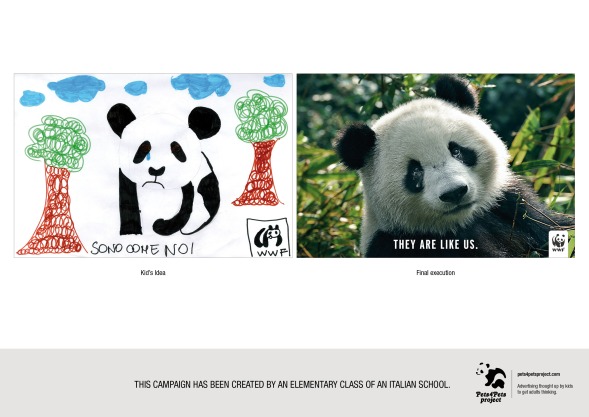
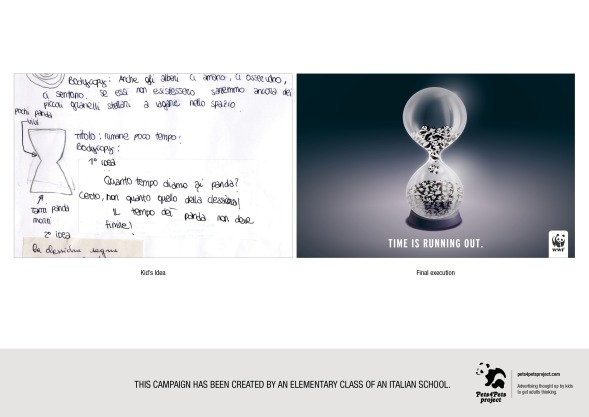
“From the first sketch on a piece of paper, to 2 TV commercials, 4 radio announcements and 8 print campaigns, ready to go on-air”. For every creative piece, you can see the “before” and “after”: from the kids’ original sketches to the final executions ready to go on-air. One thing is immediately evident: the kids’ work is already 100% creatively effective.
The team of professionals just helped them “translate” their ideas into a language that adults can understand.
Advertising Agency: Leo Burnett Italy
Executive Creative Director: Francesco Bozza
Associate Creative Director: Andrea Marzagalli
Creative Team: Andrea Stanich, Sergio Spaccavento, Paolo Boccardi, Alice Crippa, Serena Micieli, Silvia Savoia
Executive Producer: Debora Magnavacca
Year: 2013
The Bent Bullet: JFK and the Mutant Cospiracy
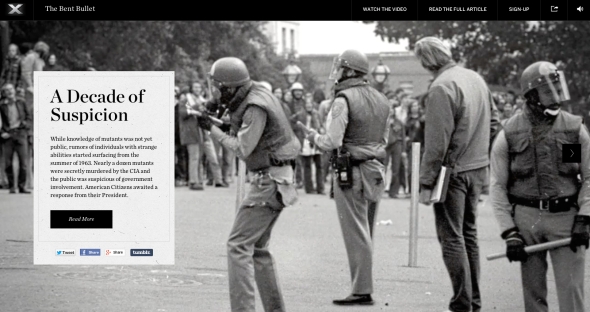
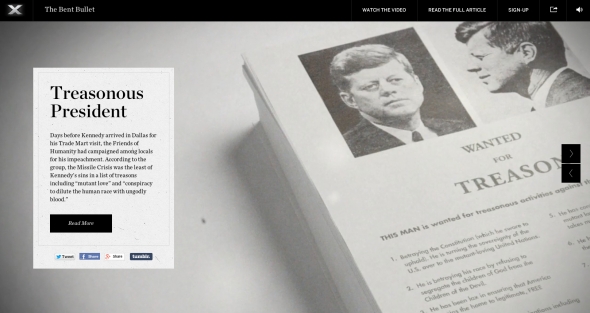
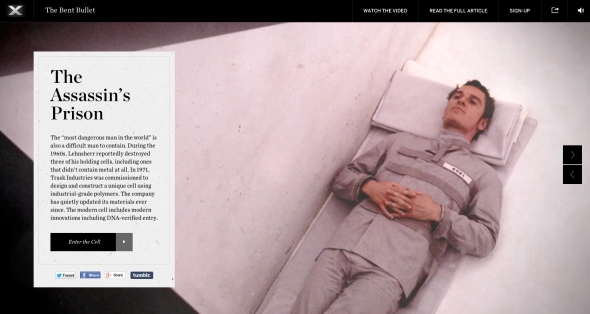
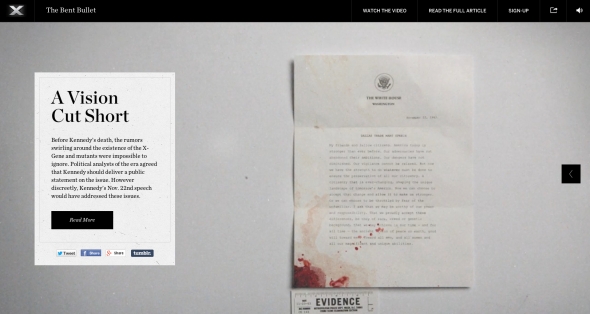
Posted: December 10, 2013 Filed under: Digital, Promotion, Social, USA, Viral | Tags: 1963, days of future, JFK, Magneto, nov. 22, the bent bullet, Viral, x-men Leave a commentMarvel has created a site called The Bent Bullet, a promotional website and video that weaves X-Men mutants in with a JFK conspiracy theory, blending the real and fictional in a quasi sort of alternative history genre getup.


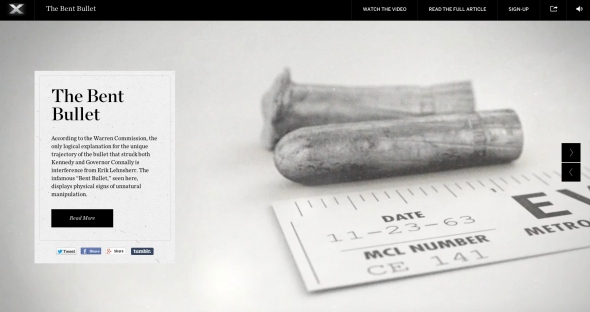
A new viral site promoting the upcoming X-Men: Days of Future Past has hit the web: The Bent Bullet, which explores President John F. Kennedy’s assassination — with an unfamiliar twist.
According to The Bent Bullet site, which went up last night, Kennedy was assassinated by Lee Harvey Oswald — with the help of Magneto (played in his young incarnation by Michael Fassbender in the movie), who allegedly used his powers on Oswald’s wild shots to ensure the president’s death. This, it seems, will be the incident that splits the X-Men timeline, triggering the dystopian Days of Future Pastuniverse, in which mutants have been rounded up in internment camps and systematically exterminated with the aid of robotic Sentinels.
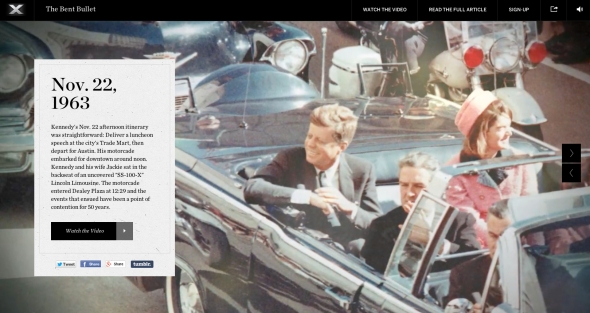
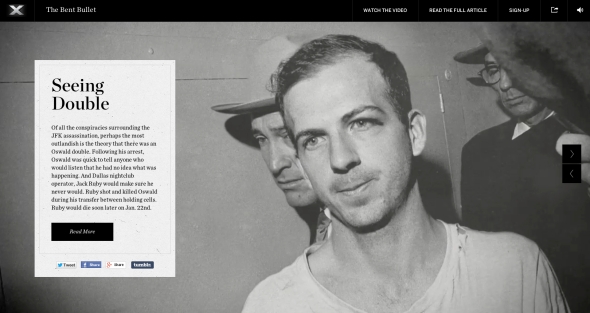
But has Magneto been falsely accused? Fictional journalist Harper Simmons seems to think so — and both Magneto’s own testimony and circumstantial evidence point to Mystique (Jennifer Lawrence) committing the assassination while disguised as Oswald, then slipping away and leaving the real Oswald to take the blame. However, it’s unclear whether she did so on Magneto’s orders, or acted autonomously following a schism in the Brotherhood of Mutants.
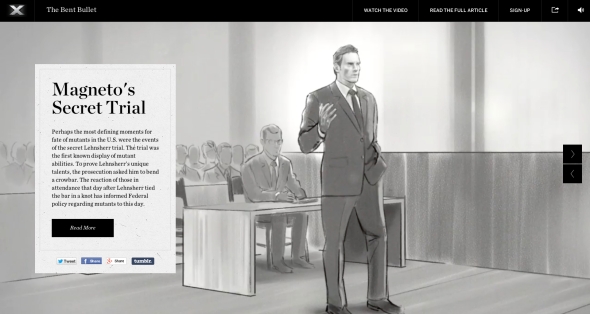
Like the rest of what we’ve seen of Days of Future Past, the movie’s take on the trigger event is based very directly on the comic, with some major modifications. In the original story, the assassin was Mystique, leading an autonomous brotherhood — but her targets were Charles Xavier, Moira McTaggart, and hardline anti-mutant senator Robert Kelly, whose cinematic counterpart died in 2000′sX-Men and was later impersonated by Mystique.
To find out just how closely the rest of Days of Future Past adheres to the comic, will have to wait until flick hits theaters May 23, 2014 — or they’ll have to hope more of these teaser sites are on the way.
CoorDown – #DammiPiùVoce (Saatchi & Saatchi Italy strikes back)
Posted: May 24, 2013 Filed under: Case History, Digital, Direct, Italy, Social, Testimonial, Viral | Tags: #dammipiùvoce, Alessandro Orlandi, Case History, Coordown, Digital, Jovanotti, Luca Lorenzini, Luca Pannese, Saatchi & Saatchi, Sharon Stone, Turn up my voice Leave a comment
Background
In Italy, due to prejudice, the basic rights of people with Down syndrome are still too often denied. With more funds available it would be possible to defend their rights.

Idea
On launch day, on the site CoorDown.it, 50 people with Down Syndrome each appeared on video appealing to 50 celebrities for a donation. But not of money: they asked them to donate a video. A video in which they, the celebrities, asked for the money to support people with Down syndrome, amplifying their voices. A video, which if then shared via the celebrities’ social networks, would have more chance of being listened to.
——————————————————————————————————————————————————————————-
Spartaco & Jovanotti
Andrea & Sharon Stone
Federico & Castrogiovanni
——————————————————————————————————————————————————————————-
Results
50 out of 50 celebrities donated a video and shared it on their social networks, including the singers Tiziano Ferro andJovanotti; the footballers Totti, Materazzi and Zanetti; the rugby player Castrogiovanni; the star chef Carlo Cracco; the Real Madrid coach Jose Mourinho and the actress Sharon Stone.
Thanks to the social networks shares and all the media coverage, the campaign reached almost 30 million people, half of the italian population. And donations were up 700%, compared to Coordown’s previous fundraising campaign.
Advertising Agency: Saatchi & Saatchi, Italy
Creative Directors: Alessandro Orlandi, Luca Lorenzini, Luca Pannese
Art Director: Luca Pannese
Copywriter: Luca Lorenzini
Social Network specialist: Flavia Pipola
Head of Interactive Production: Silvio Coco
Web Developer: Dario Cataldi
Producer: Erica Lora-Lamia
Head of TV: Raffaella Scarpetti
Editor: Fulvio Rossetti
Social Media Partner: Ambito 5
Website development: Logicweb
Partners: Top Digital, Flipper Music, Luca Bottale, H-Films, Getty Images, Google, Akita
Year: 2013
Saatchi & Saatchi Berlin/Days of Hope – Homeless People Forecast Weather on TV in Europe
Posted: January 31, 2013 Filed under: Best Use of Television, Event, Germany, Social, TV/Film | Tags: charity, Days of Hope, Germany, homeless, John Pallant, Oliver Kapusta, Romania, Saatchi & Saatchi, weather Leave a comment
Saatchi & Saatchi has launched a new campaign to raise the profile of increasing homelessness in major cities across Europe.
Called ‘Days of Hope’, the idea originates from Saatchi & Saatchi Berlin and focuses on the impact the cold January weather has on the many homeless people in Europe. Real people living on the streets are invited to a TV studio to present the weather in place of the regular weather-readers. When presenting the weather, the homeless person will allow the audience to take a closer look at their daily lives and make a request for donations to the charity.
The Saatchi & Saatchi Network collaborated to make this happen across many countries. The office in each participating country partnered with a charity that helps those living on the streets and persuaded a TV station to take part in the campaign.
Already launched in Romania and Russia, the campaign is being rolled out for Diakonie Frankfurt across Germany within the next few weeks. Switzerland will launch this week with Poland anticipated too. In Romania, the charity Samusocial is supported by Prima TV, in Russia, Spravedlivaya Pomosch is supported by TV Rain, in Serbia, Shelter is supported by TV Pvra, in Switzerland, SPS (Sozialwerke Pfarrer Sieber) is supported by TV Züri, in Poland, PCK (Polski Czerwony Krzyż) is supported by TVP INFO.
Oliver Kapusta, ECD of Saatchi & Saatchi Berlin, and creator of the idea said: “This idea is an excellent example of the power of creativity and of how the Saatchi & Saatchi family take an idea and makes it big across all borders. Originally created as a radio spot in Germany, ‘Days of Hope’ now takes place during primetime in potentially 5 countries. Who else is capable of this?”
John Pallant, Saatchi & Saatchi Regional Creative Director EMEA said: “This is a very simple, but surprising idea, which we are expecting to get a lot of attention, stimulate conversations around this important issue, and most important of all, increase donations.”
McCann Australia for Metro Trains Melbourne – Is “Dumb Ways To Die” the new “Chipotle”?
Posted: December 10, 2012 Filed under: Animation, Australia, Case History, Copywriting, Design, Digital, Graphic, Graphic Design, Illustration, Press/Outdoor, Social, Viral | Tags: Animation, be safe around trains, Case History, Chipotle, Digital, Dumb Ways to Die, Edward Gorey, funny, Is "Dumb Ways To Die" the new "Chipotle"?, John Mescall, Julian Frost, McCann Australia, Melbourne Metro, metro trains, Ollie McGill, The Gashlycrumb Tinies, Viral Leave a comment

“Dumb Ways to Die”, is an integrated advertising campaign designed to curb the number of train-related deaths in Victoria. The campaign is centred around a three-minute animated music video, highlighting the many dumb ways there are to die, with being hit by a train – a very preventable death – among them. The video and iTunes single are accessible online at DumbWaysToDie.com, with animated gifs being released on Tumblr, on radio, in posters on small and large space outdoor and throughout the Metro Trains network, with the lyrics to the song on the art work.

The Idea: Safety PSAs are gloomy and tedious and largely ignored by young people hardwired to resist them—except when they’re irresistibly fun and impossible not to share with friends. McCann Australia managed just such an evolution of the genre with “Dumb Ways to Die” its animated train-safety spot for the Melbourne Metro. The three-minute music video shows adorable blobs making the stupidest decisions ever—messing with animals, sticking forks in toasters, eating superglue, etc.—leading to all sorts of gruesome, fatal accidents. The dumbest way to die, the ad suggests at the end, is by being careless around trains. “The idea for a song started from a very simple premise: What if we disguised a worthy safety message inside something that didn’t feel at all like a safety message?” said McCann executive creative director John Mescall. “So we thought about what the complete opposite of a serious safety message would be and came to the conclusion it was an insanely happy and cute song.” With more than 30 million YouTube views, it seems happy, cute and grisly was the way to go.
The Song: The song begins, “Set fire to your hair/Poke a stick at a grizzly bear/Eat medicine that’s out of date/Use your private parts as piranha bait,” before the chorus repeats the two lines, “Dumb ways to die/So many dumb ways to die.” Mescall wrote most of the lyrics in one night at the agency. “It then took a few weeks of finessing,” he said, “getting rid of a few lines that weren’t funny enough and replacing them with new ones.” The line “Sell both your kidneys on the Internet” was a late inclusion. “I’m glad it’s there. It’s my favorite,” he said.

Australian musician Ollie McGill from the band The Cat Empire wrote the music. “We basically gave him the lyrics and told him to set it to the catchiest nonadvertising type music he could,” said Mescall. McGill delivered something almost unbearably catchy. “The melody is easy to remember and sing along to, the lyrics are fun, bite-sized chunks of naughtiness, and the vocals have just the right amount of knowing innocence,” Mescall said. “It’s a song that you want to hate for living in your head, but you can’t bring yourself to hate it because it’s also so bloody likable.” The singer is Emily Lubitz of another Australian band, Tinpan Orange. (The song is credited to Tangerine Kitty, which is a mashup of the two band names.) “Emily brought a great combination of innocence, playfulness and vocal integrity,” Mescall said. “She brings a level of vocal quality you don’t normally get on a video about cartoon death.”
The Art Direction: Australian designer Julian Frost did the animation. “We gave him the most open brief we could: Just make it really funny and really awesome and do it to please yourself,” said Mescall. The visual reference points ranged from Edward Gorey’s The Gashlycrumb Tinies to Monty Python’s “Always Look on the Bright Side of Life” (which showed men singing while being crucified) to “any number of hokey indie music-video flash mobs you see on YouTube,” said Mescall.


“Julian was keen to contrast the extreme situations described in the lyrics with the simplest animation possible. Otherwise it would become just too much.” After the spot blew up online, Frost wrote on his website: “Well, the Internet likes dead things waaay more than I expected. Hooray, my childish sense of humor pays off at last.”


The spot lives online, in short bursts on music TV, and may reach cinemas. The campaign is also running in radio, print and outdoor. The song is on iTunes, where it reached the top 10. The agency is also producing a book as well as a smartphone game that should be ready by Christmas.
Advertising Agency: McCann, Melbourne
Executive Creative Director: John Mescall
Creative Team: John Mescall, Pat Baron
Animation: Julian Frost
Digital Team: Huey Groves, Christian Stocker
Year: 2012
Leo Burnett for Think!/Road Safety Campaign – Man Trapped in Pint Glass
Posted: December 6, 2012 Filed under: Ambient, Awards, Case History, Installation, Social, UK | Tags: Ambient, Bertie Scrase, Guy Moore, installation, Leo Burnett, Man trapped in pint glass, Paddington Station, Phillip Deacon, Road safety campaign, Think!, Tony Malcom Leave a comment
Agency Leo Burnett did some research and found that anti-drink-driving advertising based around crashing and injury was no longer likely to effect the target demographic of young male drivers who don’t believe that driving after drinking a couple of beers is dangerous. The agency found that low-consumption male drink-drivers were more likely to be deterred by personal consequences of a drink-driving conviction.
The idea of this campaign was to play against the seasonal jollity of the Christmas period and to dramatize the experience of isolation, regret and stigmatization brought about by a drink-driving conviction. In December 2007 a real-life convicted drink-driver agreed to be placed inside a specially constructed upturned pint glass. He was thus trapped by his seemingly innocuous decision to get behind the wheel after having one pint too many. The subject was interviewed by national press and broadcast media in Paddington Station as he explained how being convicted of a drink-driving offence had ruined his life: he had lost his job, his girlfriend, his car and a lot of money. An actor then took over the role of the drink-driver up and down the country at locations specially chosen for their proximity to public car parks and areas with a high concentration of pubs and bars (particulary those used by football fans).

The campaign is thought to have contributed to a drop of 20% in breath test failures during the pre-Christmas period of 2007.
Advertising Agency: Leo Burnett London
Creative Directors: Tony Malcom, Guy Moore
Creatives: Phillip Deacon, Bertie Scrase
Year: 2007
25 Advertising Ideas for 25 November: International Day for the Elimination of Violence against Women
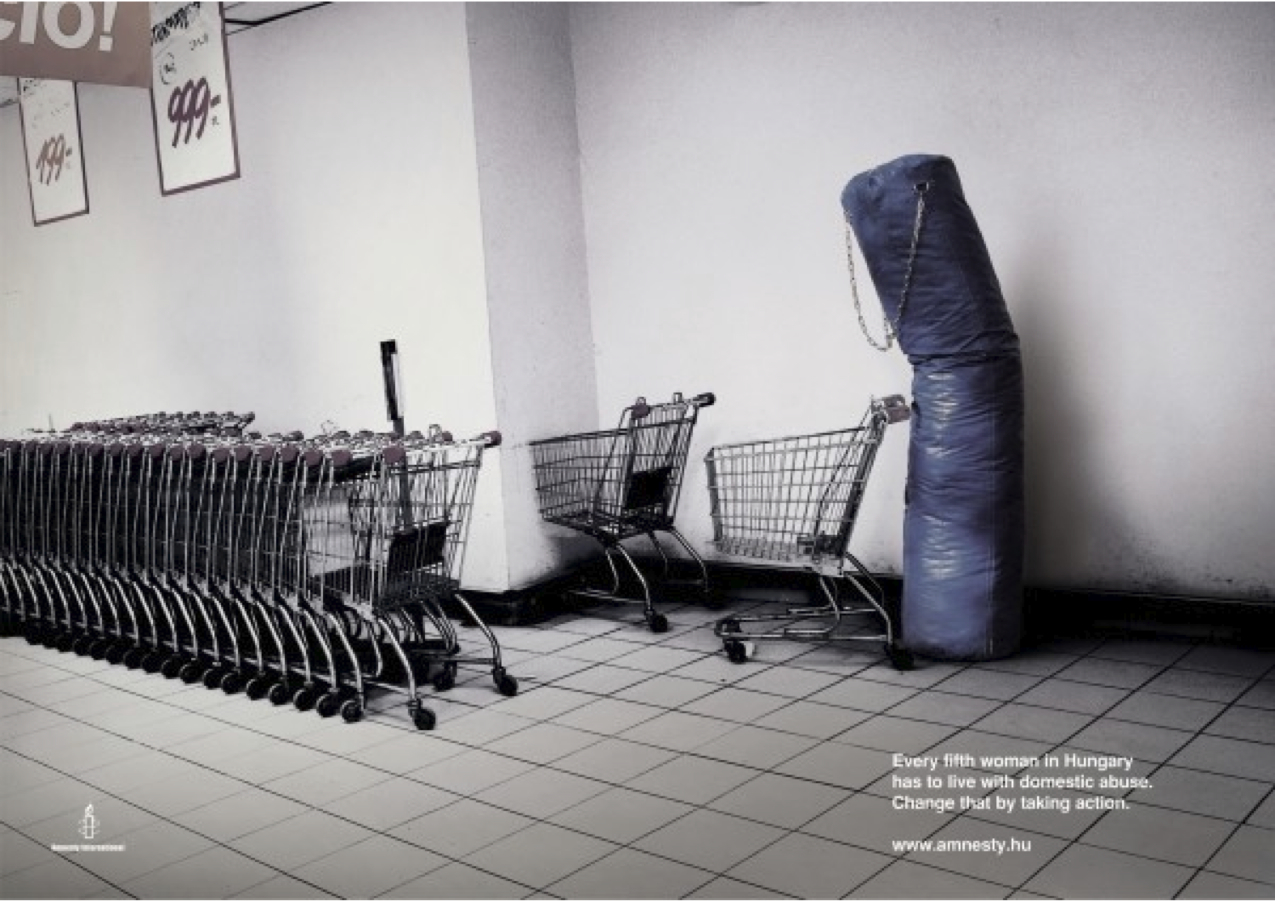
Posted: November 26, 2012 Filed under: Awards, Belgium, Cannes Lions, Cliché, Event, France, Germany, Hungary, India, Italy, Mexico, Press/Outdoor, Singapore, Social, UK, USA | Tags: 25 november, abused women, Amnesty International, apav, Baf, domestic violence, International Day for the Elimination of Violence against Women, United Colors of Benetton Leave a comment01 – Amnesty International


02 – BaF (Bundesverband autonomer Frauennotrufe)
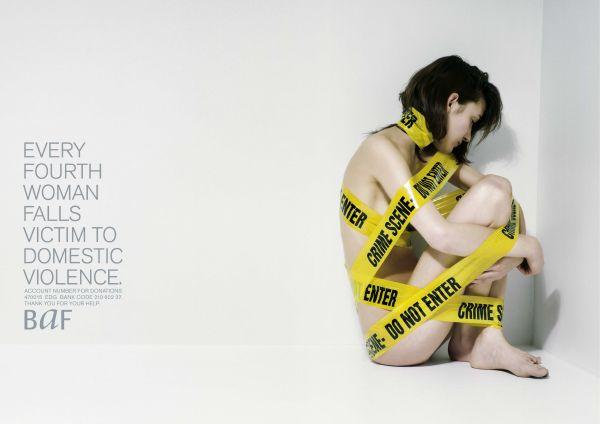
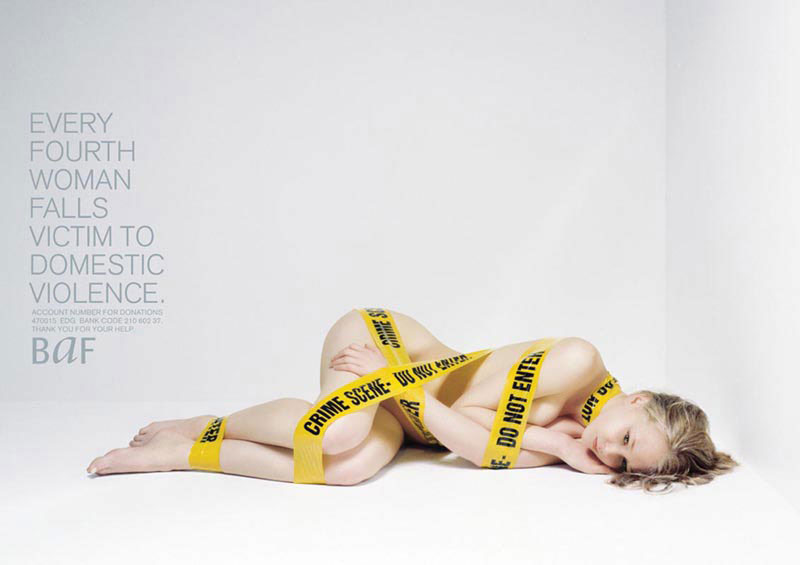

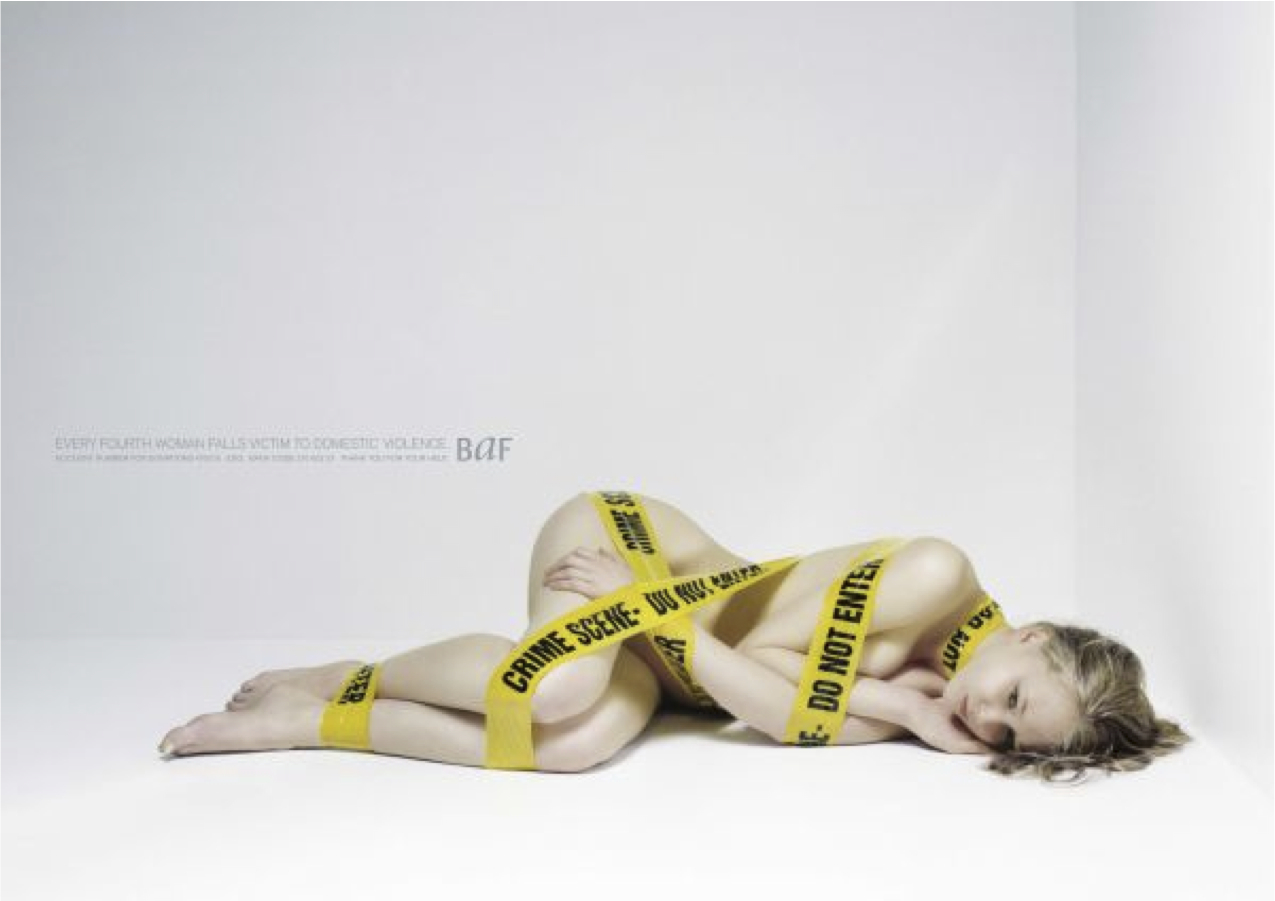
03 – United Colors of Benetton


04 – Domestic Violence Vigilance (USA)


05 – Aware Helpline Singapore


06 – APAV (Victim Suport)

07 – Refuge.org.uk


08 – APAV (Victim Support)


09 – Florencia (Service for abused women)


10 – Citizens Against Spouse Abuse


11 – Amnesty International

12 – Amnesty International
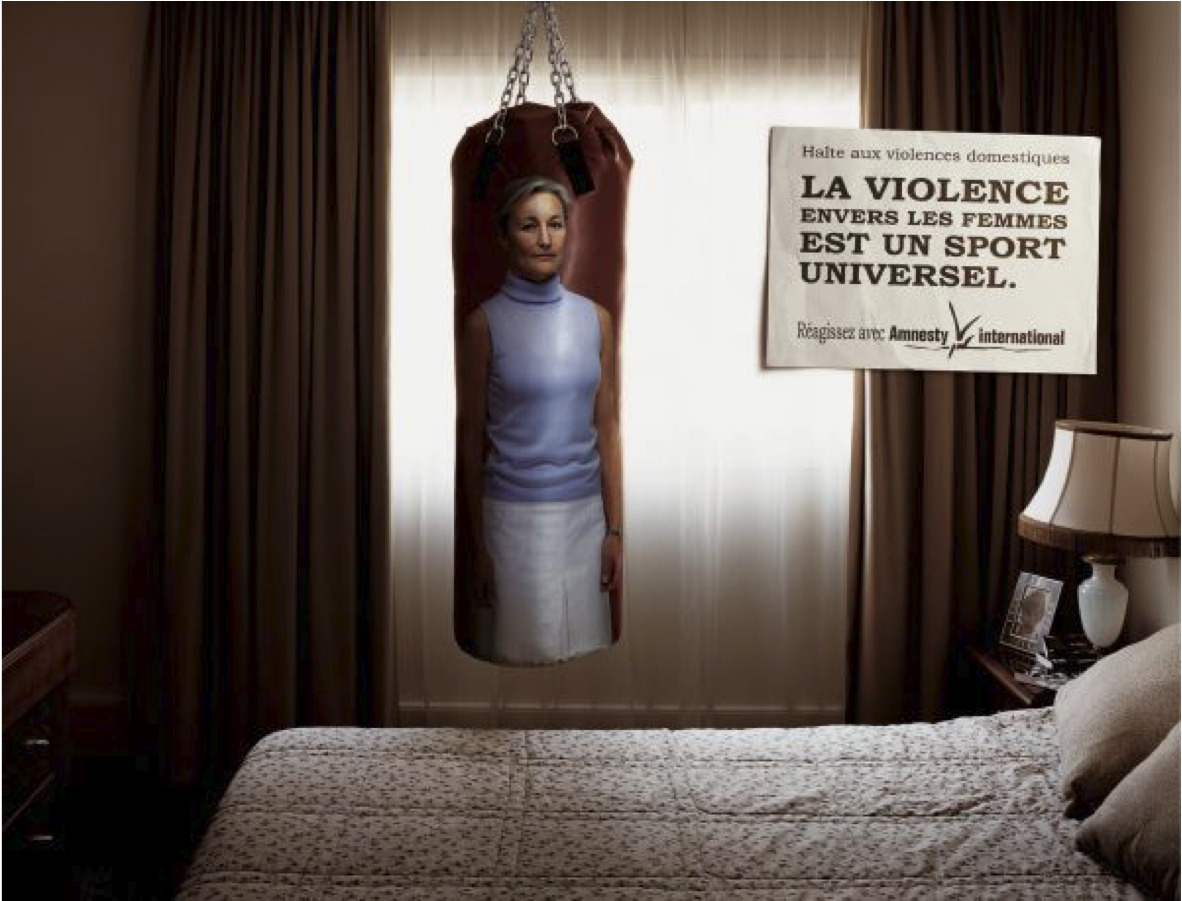

13 – Women’s Aid Organisation


14 – The Youth, Women, Children and Family Chamber (Panama)


15 – Amnesty International


16 – Amnesty International

17 – Amnesty International

18 – NO (Combat Violence Against Women Helpline)


19 – http://www.terres-des-femmes.ch


20 – Associazione Donne Insieme contro la Violenza


21 – Ni Puter Ni Soumises


22 – Mar’A (Against Domestic Violence)
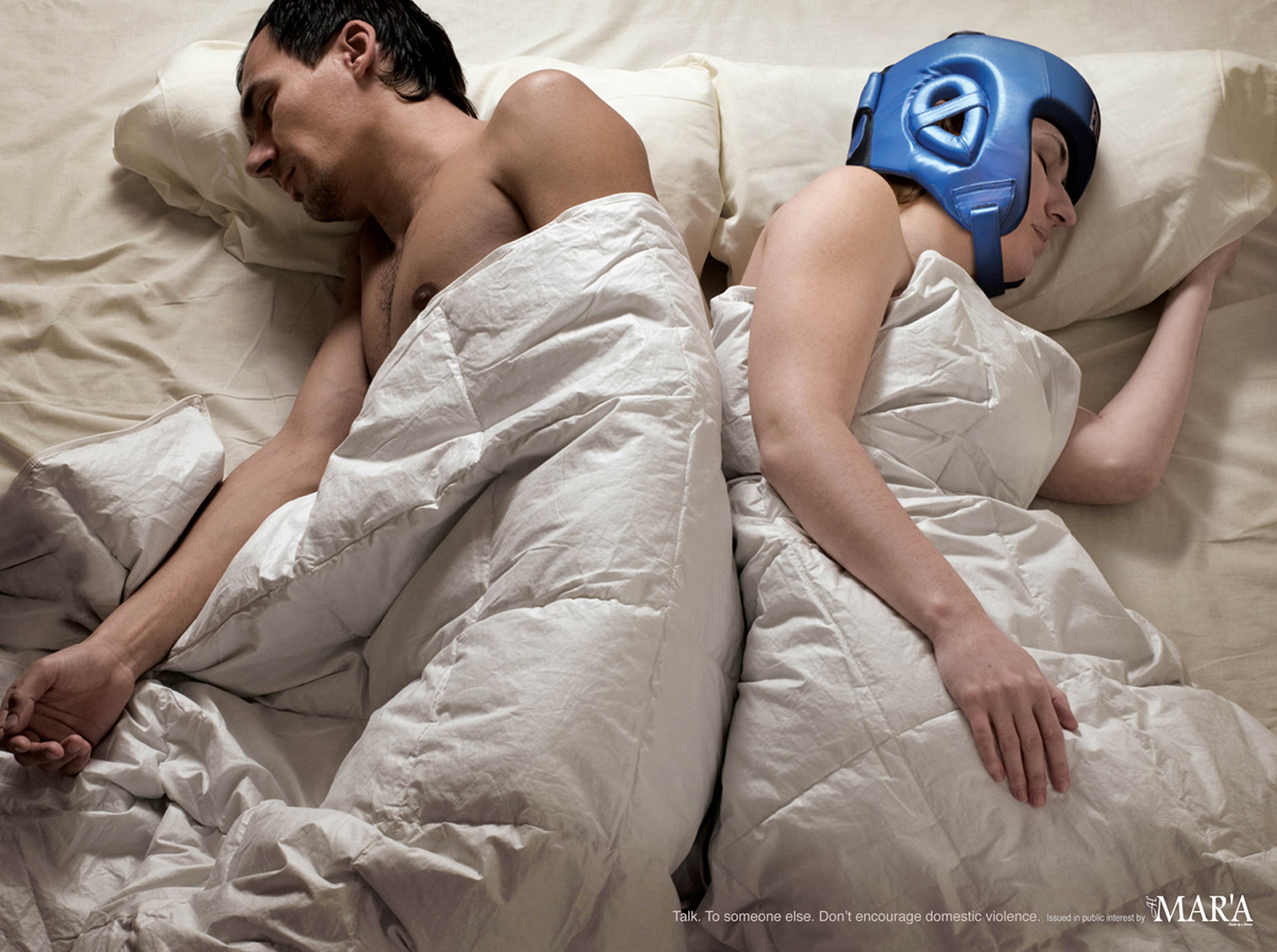
23 – Amnesty International

24 – Solidaritè Femmes


25 – NSW (Women’s Refuge Movement)

United Colors of Benetton – Unemployee Of The Year
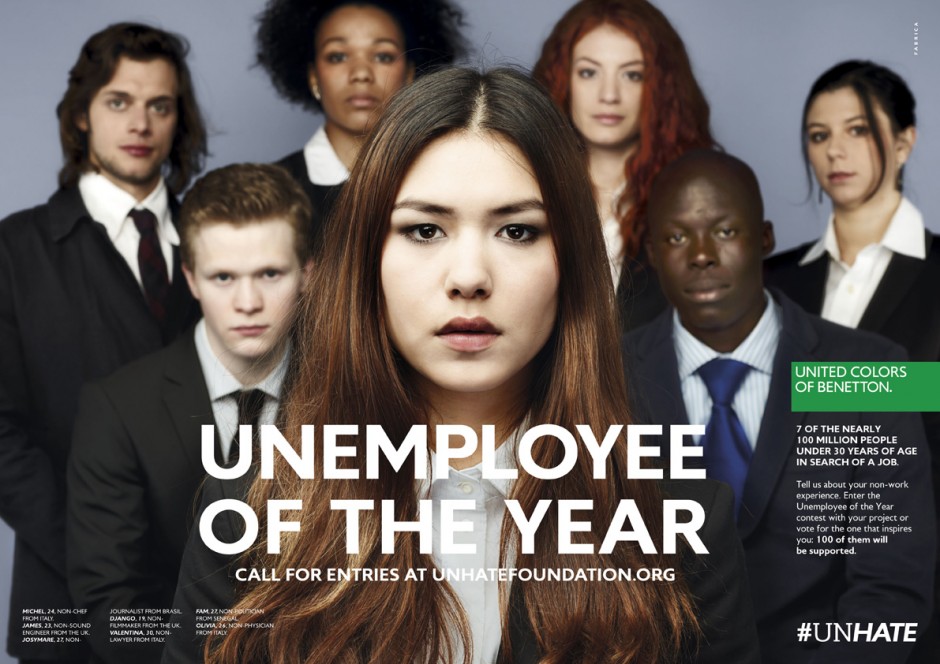
Posted: September 18, 2012 Filed under: Case History, Digital, Direct, Event, Italy, Press/Outdoor, Promotion, Social, The Nederlands, TV/Film | Tags: 72andSunny, advertising, alessandro benetton, call for entry, Case History, dignity, Fabrica, Italy, Promotion, TV/Film, Unemployee of the year, unhate, United Colors of Benetton 2 CommentsUnited Colors of Benetton has launched “Unemployee of the Year”, a a contest created for young people all over the world, aiming to award 100 projects proposed and voted by the online community. The project, promoted by the UNHATE Foundation, aims to spread a positive message of hope and celebrate young people’s ingenuity, creativity, and their ability to create new smart ways of addressing the problem of unemployment.


For decades, Benetton, the Italian apparel retailer, has been known for provocative advertising that attracts publicity by stirring up discussion of contentious topics like politics, religion and the treatment of AIDS patients. For almost as long, critics have dismissed the ads as exploitative because they do not offer solutions to the problems or assistance to the causes that could use financial help.
Now, however, Benetton is going to put some money where its mouth is — 500,000 euros, to be exact, or about $650,000. A campaign that begins on Tuesday for the United Colors of Benetton brand, and is devoted to the problem of youth unemployment, includes a contest to find worthwhile projects suggested by unemployed young people, who will receive financing from a Benetton foundation.
Information about the contest, called Unemployee of the Year, will be available at unhatefoundation.org, the Web site of the Unhate Foundation, which is named after a campaign carrying the theme of “unhate” that Benetton ran last year.
The contest will be open to unemployed people, ages 18 to 30. They are being asked to submit to the Web site ideas for projects — nonprofit or not — that would improve lives in their communities. Visitors who register at the site will vote on their favorite proposals, and the Unhate Foundation will give the people behind 100 winning projects 5,000 euros each, totaling 500,000 euros. The money to be awarded the winners is a small sum compared with the estimated budget for the Unemployee of the Year campaign, which is 20 million euros, or about $26.2 million. But it is a major commitment compared with what Benetton has spent until now on the issues addressed by its ads.
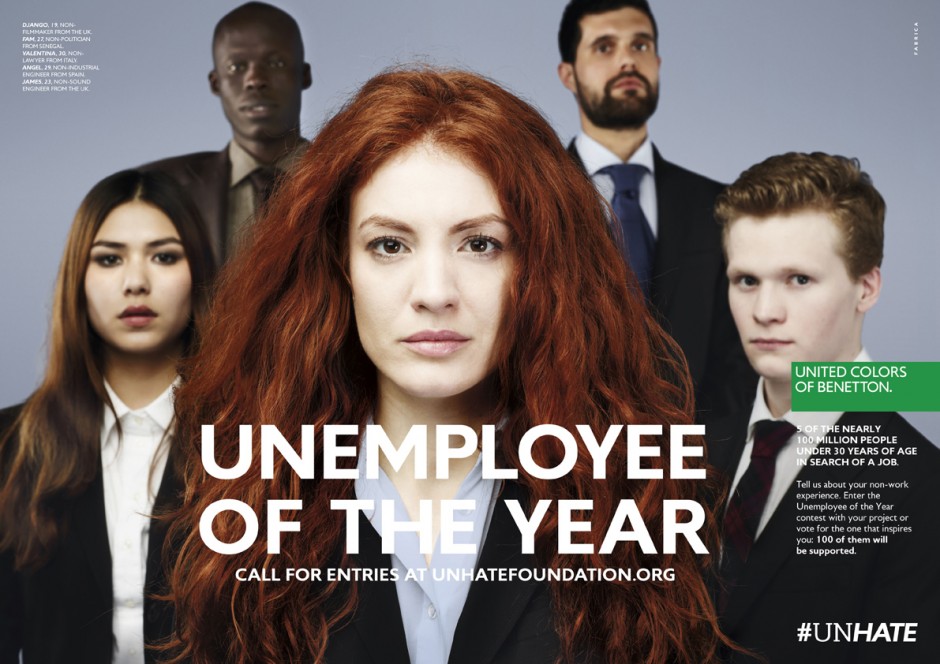
The goal is “a new generation of Benetton, a Benetton 2.0,” Alessandro Benetton, who in April became chairman of the Benetton Group, said in a phone interview last week. The difference now is that when Benetton seeks to “talk about contemporary social issues,” Mr. Benetton said, the campaign “needs to have a practical response to the problems we’re raising. Not by ourselves are we going to change the world,” he added. “But we want to set an example.” Mr. Benetton said he hoped people would be surprised to see the company spending money to promote “values in which we believe. And I hope it’s something many other companies are doing,” he added.
The campaign is being created by Fabrica, the internal Benetton agency, in collaboration with the Amsterdam office of 72andSunny, an agency owned by MDC Partners.
The campaign includes a commercial in which young people in countries around the world are shown trying hard to find jobs. Some take part in a demonstration, holding banners with uplifting messages like “Dignity.”
“That is meant to counter the widespread complaints directed at jobless youth” Mr. Benetton said, “charging them with being “lazy” or being “anarchists,” or that it is somehow “their own fault” they are unemployed.”


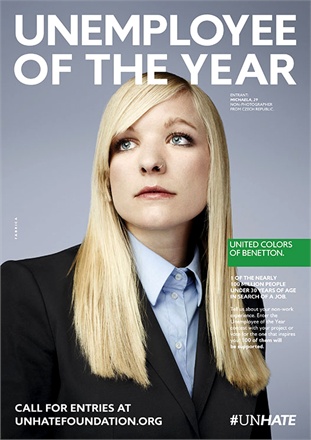
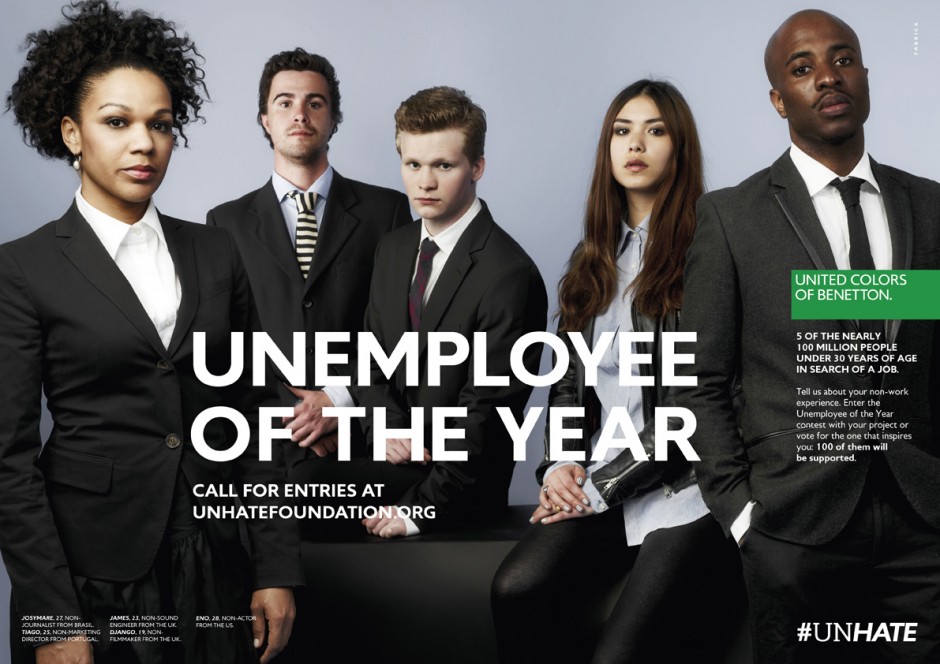
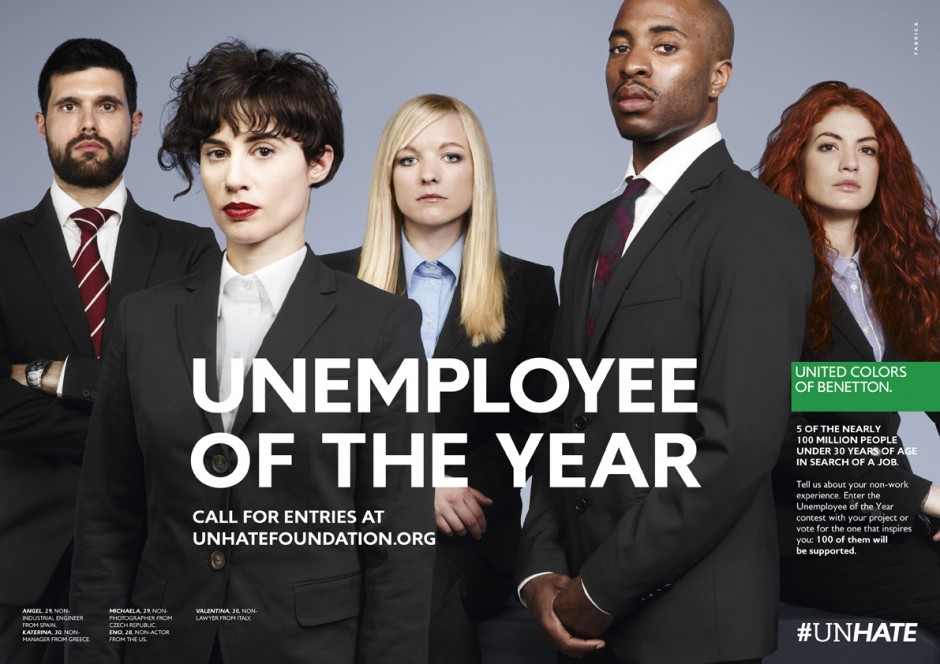
There are also print ads in the campaign, which present portrait-style photographs of well-dressed unemployed young men and women. The subjects of the print ads are identified with phrases like “Angel, 29, non-industrial engineer from Spain,” “Valentina, 30, non-lawyer from Italy” and “Eno, 28, non-actor from the U.S.”
Advertising Agency: Fabrica/72andSunny
Year: 2012
Songvertising – 32 best commercials with singing people
Posted: July 12, 2012 Filed under: Alcoholic Drinks, Argentina, Australia, Axe, Best Use of Television, Beverages, Cannes Lions, Car, Coca-Cola, New Zealand, Norway, Social, South Africa, Spain, Testimonial, TV/Film, UK, USA, Viral | Tags: 32 best commercials with singing people, Argentina, arnet, basf, BBDO, BBH, Big Ad, boy band, Burger King, Cadbury Dairy Milk, Carlton Draught, choir, Coca-Cola, Crispin Porter + Bogusky, dear john, Del Campo Nazca Saatchi & Saatchi, Diesel, Droga5, Fallon, google demo slam, Heineken, Hilltop, Honda, i would run to you, Impossible dream, Michael Jackson, mow the lawn, Nike, Norte Beer, numa numa, pepsi, pretty, Puma, rexona, Saatchi & Saatchi, singing cowboy, Songvertising, Starbucks, t-mobile, TV/Film, welcome back, Wieden + Kennedy, wilkinson, yeo valley Leave a comment
1 – YEO VALLEY ORGANIC – Boyband
In a follow-up to last year’s rapping farmers ad, Yeo Valley launched a tv spot during the first ad break of The X Factor live show. The one-off, two-minute music video features a farming-inspired boy band called The Churned, singing a ballad entitled Forever. The ad was shot on location in Blagdon, in the heart of rural Somerset. The launch tied in with a Facebook karaoke competition, where users could sing along to the Yeo Valley track. The winner appeared in a 30-second version of the ad, which ran during the X Factor final on 11 December.
Advertising Agency: BBH London
Year: 2012
Shortlist
—————————————————————————————————————————————————————————–
2 – CARLTON DRAUGHT – Big Ad
An epic send-up of big budget ads, featuring a cast of thousands. Song lyrics: “It’s a big ad / very big ad/ it’s a big ad we’re in./ It’s a big ad/ my God it’s big/ can’t believe how big it is/ it’s a big ad for Carlton Draught / It’s just so freaking huge! / It’s a big ad/ expensive ad! / This ad better sell some bloooooody beer!!!
Advertising Agency: George Patterson Y&R, Melbourne
Year: 2006
Gold Lion
—————————————————————————————————————————————————————————–
3 – PUMA – Hardchorus
We open on a small group of hardcore soccer fans, also known as hooligans, standing in a classic British pub. Suddenly, one of them starts singing the first words of “Truly, Madly, Deeply” by Savage Garden. Another hooligan joins in, and as the camera pulls out, we see that the whole pub is packed with hooligans. They all sing together with the power of an entire stadium of fans during a soccer game, turning the cheesy love song into something big, beautiful and romantic. After the last chorus, a super appears: “It’s match day. It’s Valentine’s Day. Let your better half know how you feel. Dedicate and send this song at pumahardchorus.com”. Followed by Puma’s “Love = football” next to the Puma logo.
Advertising Agency: Droga5
Year: 2010
Gold Lion for the Campaign
—————————————————————————————————————————————————————————
4 – NORTE BEER – It’s Good to Have Friends
Beer means friendship, and this campaings presents in funny way the different kind of friends we all have.
Advertising Agency: Del Campo/Nazca Saatchi & Saatchi, Buenos Aires
Year: 2009
Silver Lion for the Campaign
—————————————————————————————————————————————————————————-
5 – T-MOBILE – Welcome Back
On October 27th 2010, thousands of unsuspecting passengers arriving at Heathrow’s Terminal 5 were given a welcome home to remember. People were greeted by a 300 strong choir and vocal orchestra singing a medley of songs, completely a cappella, to welcome them back into the country.
Advertising Agency: Saatchi & Satchi, London
Year: 2011
Silver Lion
—————————————————————————————————————————————————————————–
6 – COCA-COLA – Hilltop
Advertising Agency: McCann Erikson
Year: 1971
—————————————————————————————————————————————————————————–
7 – HEINEKEN – Singer
A blues singer can’t sing the blues – his life is too contented. A sip of lager soon changes that. Heineken refreshes his blueness.
Advertising Agency: Lowe Haward- Spink, UK
Year: 1992
Gold Lion
—————————————————————————————————————————————————————————–
8 – HONDA – Impossible Dream
A man travels on an incredible journey using some of Honda’s landmark products whilst miming to the Andy Williams song ‘The Impossible Dream’. His journey comes to an abrupt end when he leaps off a giant waterfall in a Honda Powerboat into the mist below. Surely, this is the end of his dream? However as Andy Williams reaches the crescendo of the song, our hero returns in a Honda Hot Air Balloon to finish off the song in style. Garrison Keillor – the voice of Honda – sums it all up with ‘I couldn’t have put it better myself’.
Advertising Agency: Wieden + Kennedy, London
Year: 2006
Gold Lion
—————————————————————————————————————————————————————————–
9 – COCA-COLA – Choir
Here’s Coca-Cola celebrating along with Santo its 125th year, and once again, we are guilty of naivety. We believe that, even today, the world is not far from the world that we dream of. In fact we are so naïve about thinking this way, that we decided to carry out an investigation to evaluate just how justified our reasons to believe in a better world were. We are proud to present to you “Choir”, created by Santo for Coca-Cola Latin America and their new communications platform: “REASONS TO BELIEVE IN A BETTER WORLD”.
Advertising Agency: Santo, Buenos Aires
Year: 2011
Silver Lion
—————————————————————————————————————————————————————————–
10 – T-MOBILE – Singalong
When T-Mobile invited the British public to be part of their next event, people turned up to Trafalgar Square, not knowing what they were letting themselves in for. Thousands of microphones were handed out as it was revealed they’d all be singing karaoke together. After a number of songs, and with a surprise guest appearance from Pink, the event culminated with everyone singing the timeless classic, ‘Hey Jude’
Advertising Agency: Saatchi & Satchi, London
Year: 2010
Shortlist
—————————————————————————————————————————————————————————–
11 – NIKE FREE RUN – I Would Run to You
Love makes people do crazy things. Like run across the country. See how strong running reunites a long distance couple.
Advertising Agency: Wieden + Kennedy, Portland
Year: 2012
Bronze Lion
—————————————————————————————————————————————————————————–
12 – NIKE – Pretty
As Maria Sharapova marches to her tennis match, she passes people who sing I Feel Pretty. She slams a ball cross to court, putting an end to the singing.
Advertising Agency: Wieden + Kennedy, Portland
Year: 2007
Gold Lion
—————————————————————————————————————————————————————————–
13 – BASF – Dear John
The ad, set in army camp, features a soldier receiving a letter which goes to the tune of “Dear John”, the country song written by Lewis Talley, Fuzzy Owen and Billy Barton and made popular by Jean Shepard during the Korean war. As the song finishes the sergeant adapts the classic line from Humphrey Bogart, “Play it again John”.
Advertising Agency: Colenso BBDO, NZ
Year: 1982
Gold Lion
—————————————————————————————————————————————————————————–
14 – REXONA – Sensitive Armpits
A tough lumberjack is chopping down a tree. As he rearranges his cap, we notice at the same time he does that his underarm begins to song a sweet song. The corny melody is really annoying him. At this point, we see different cliché images of rough and tough men all undergoing the same situation. Finally, one of them applies the New Rexona Men Sensitive and succeeds in shutting up the underarm voice. A male voice in off says: New Rexona Men Sensitive. Even the most insensitive guy can have sensitive underarms.
Advertising Agency: Ponce Buenos Aires
Year: 2011
Silver Lion
—————————————————————————————————————————————————————————–
15 – STARBUCKS – Glen
Glen jumpstarts his day by drinking a Starbucks DoubleShot. As he opens the can, Survivor appears in his apartment. They follow Glen through his full morning routine, singing a personalized version of “Eye of the Tiger.”
Advertising Agency: Fallon, New York
Year: 2004
Shortlist
—————————————————————————————————————————————————————————–
16 – GOOGLE – Demo Slam: Realtime Karaoke
Google is more than just a search bar. However, most of us don’t use, let alone, are aware of its many features. We needed to find a way to share all this free technology with the world. To educate everyone about all of Google’s innovations; we decided to change the way people learnt about it. We got precisely the people who didn’t use this free tech, to explain to the others why they should. Because, only they would be able to explain it in a way that would be fun to watch, and understood by all. By bringing in just a little bit of courage, creativity and fun; each of them pushed the role of technology in our lives and inspired the rest to use it in ways never imagined before.
Transforming something few were aware of to something the whole world cared about; we were able to re-define the role of technology in everyone’s life. From celebrities, scientists, soccer moms, teens to even sports personalities; everyone came forward to find new ways in which technology could make their world a little better.
Advertising Agency: Johannes Leonardo, NY
Year: 2011
Gold Lion for the Campaign
—————————————————————————————————————————————————————————–
17 – DISCOVERY CHANNEL – I Love the World
We developed a new brand idea for Discovery Channel: Discovery is the
World’s Biggest Fan of the World. We wanted to celebrate all that is epic, beautiful, inspiring, fun and just plain crazy in the world. Fellow fans—from spacewalking Astronauts to Alaskan fishermen to Zulu warriors to Stephen Hawking to Discovery hosts like Mike Rowe and Bear Grylls—sing along to an old campfire song re-written to express how each of them loves the world. In other words, to tell people why Discovery Channel thinks “The World is Just Awesome.”
Advertising Agency: 72ndSunny, USA
Year: 2008
Shortlist
—————————————————————————————————————————————————————————–
18 – MATCH.COM – Piano
This is a film for the online dating service, Match.com, which features a couple finding each other as they examine musical instruments. He strums a guitar and she plays a keyboard. Together they make beautiful music, and it’s clearly the start of something special.
Advertising Agency: Mother, London
Year: 2010
Gold Lion
—————————————————————————————————————————————————————————–
19 – WILKINSON – Mow the Lawn
Girls in a front yard sing about mowing the lawn in order to promote Wilkinson/Schick Quattro razors for women.
Advertising Agency: JWT, New York
Year: 2009
—————————————————————————————————————————————————————————–
20 – AMERICAN LEGACY FOUNDATION/TRUTH – Singing Cowboy
We saddled up a horse, found a modern day cowboy that happened to have a hole in his neck due to a tobacco-related laryngectomy, and sent him to Manhattan to sing.
Advertising Agency: Arnold/Crispin Porter + Bogusky, USA
Year: 2007
Bronze Lion
—————————————————————————————————————————————————————————–
21 – ARNET BROABAND – Numa Numa
The ad shows some of the funny stuff you can find on the Internet.
Advertising Agency: Santo, Buenos Aires
Year: 2007
Shortlist
—————————————————————————————————————————————————————————–
22 – EVIAN – Voices
A man in a lift, a jogger, a secretary by the photocopier, a man in his car, an elderly lady…in all these scenes from everyday life, we see people singing with their childish voices.
Advertising Agency: BETC Euro RSCG, Paris
Year: 2003
Shortlist
—————————————————————————————————————————————————————————–
23 – NIKE WOMEN – Surgery
A group of women run away from a plastic surgery clinic dancing a choreography to a reggaetón tune.
Advertising Agency: Madre, Buenos Aires
Year: 2007
Bronze Lion
—————————————————————————————————————————————————————————–
24 – DIESEL – Anthem
Sing-a -ong Diesel Island national anthem. Why is your country fucked up?
Advertising Agency: Santo, Buenos Aires
Year: 2011
Silver Lion for the Campaign
—————————————————————————————————————————————————————————–
25 – PROCTER & GAMBLE – You’ll Never Walk Alone
This 60-second commercial shows a lifetime of moms by their children’s sides doing the daily, sometimes mundane, things that help their children grow up to be Olympians. All the while, they sing “You’ll Never Walk Alone” from the Rodgers & Hammerstein musical Carousel. The ad builds from a child’s birth and culminates with the Olympics and a proud mom seeing all her hard work pay off. We then cut to a card that says, “Thank you, Mom,” followed by a series of product brand images that ends on the P&G logo with the voice-over, “P&G. Proud sponsor of Moms.”
Advertising Agency: Wieden + Kennedy, Portland
Year: 2010
Bronze Lion for the Campaign
—————————————————————————————————————————————————————————–
26 – BURGER KING – Americas Favorite/More Mayo/More Cheese
Introducing the Whopperettes.
The Whopperettes return with a story about extra cheese.
The Whopperettes return with a story about mayo.
Advertising Agency: Crispin Porter + Bogusky
Year: 2006
Silver Lion for the Campaign
—————————————————————————————————————————————————————————–
27 – CADBURY DAIRY MILK – Night Runner
Fallon and Cadbury keep Great Britain pumped for the Olympics with a new spot that re-creates “The Final Countdown” — but adds multiple voices singing from the towers and buildings while a runner makes his way, presumably, to the Olympic Gold. An accompanying interactive feature encourages Britons to upload videos of them singing similarly inspirational songs to help team GB to victory.
Advertising Agency: Fallon London
Year: 2012
—————————————————————————————————————————————————————————–
28 – LOTTO LOTTERY – Ballroom Blitz
A taxi driver refuses to let passengers into his cab. Instead, he walks over to the queue and starts to sing for them. The man who joins in is chosen as the lucky passenger.
Advertising Agency: New Deal DDB, Norway
Year: 2001
Bronze Lion
—————————————————————————————————————————————————————————–
29 – CADBURY DAIRY MILK – Simply the Best
Part of Cadbury’s “Keep Team GB Pumped” campaign for London 2012 Olympics, swimmer Rebecca Adlington is serenaded by royal guards, dinner ladies and butchers with Tina Turner’s “Simply the Best.”
Advertising Agency: Hypernaked, London
Year: 2012
—————————————————————————————————————————————————————————–
30 – AMP ENERGY DRINK – Walk of no Shame
AMP wanted to introduce three new products with specific energy functions, designed to help our target, people who live their lives to the fullest. We also needed to increase brand awareness and embed ourselves into their daily life. We wanted to be the most relevant, unlike our hyper-masculine energy competitors. “Walk of No Shame” was an ode to the infamous walk that young people take “the night after” going out. With the look and sound of a mini-musical, AMP showed how one can take a “walk of no shame” as it gets you back on your feet.
Advertising Agency: BBDO New York
Year: 2009
Shortlist
—————————————————————————————————————————————————————————–
31 – LABATT BLUE BEER – Big Song
A young man tries to make up to his girlfriend by singing her a song around a campfire – “Out of the Blue”, and it turns into a huge sing-a-long.
Advertising Agency: Ammirati Puris, Canada
Year: 2001
—————————————————————————————————————————————————————————–
32 – PEPSI – Pepsi Generation
Advertising Agency: BBDO, USA
Year: 1984
Saatchi & Saatchi Italy for World Down Syndrome Day – The Coordown Project
Posted: May 21, 2012 Filed under: Best Use of Television, Case History, Italy, Press/Outdoor, Social, TV/Film | Tags: Agostino Toscana, Alessandro Orlandi, Case History, Coordown Project, Down syndrome, integration day, Luca Lorenzini, Luca Pannese, Saatchi & Saatchi, Sergio Silvestre, TV/Film, World Down Syndrome Day 1 Comment
People with Down Syndrome can be part of society and actively contribute to its development. The Coordown organization campaigns for the integration of people with Down Syndrome in society and, in particular, the work enviroment. On the 21st of March, on World Down Syndrome Day, we promoted this in an exceptional way.
“We are very proud to participate in this project. We were struck by the innovative style of this project, communicating the importance and the normality of diversity through the tool that permeates our daily lives and that captures our attention in every moment of the day: advertising. We are proud to contribute to the dissemination of this message, which contains the values central to the Toyota philosophy which always put the person first, clients on one side and the employees on the other side, as a vital resource. People with their talent and passion, variety and diversity that make our company a great company.” – Lorenzo Matthias – Public Relations General Manager at Toyota Motor Italy.
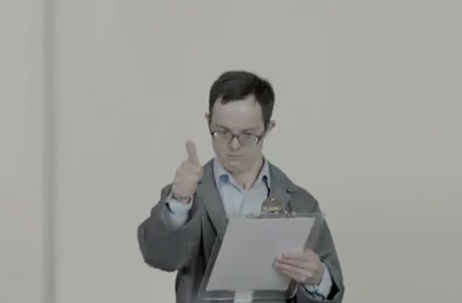
On that day, alternative versions of the commercials of some of the most well known national and international brands (Illy Coffee, Averna Liqueur, Cartasi Credit card, Toyota, Pampers) were broadcast on tv. During filming, we had shot alternative scenes in which the original actor was substituted by an actor with Down Syndrome. These alternative versions appeared 334 times that day.
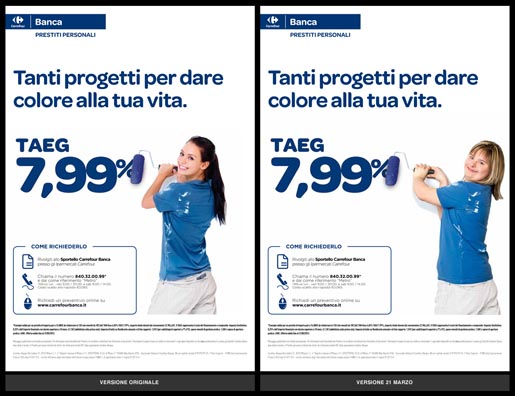

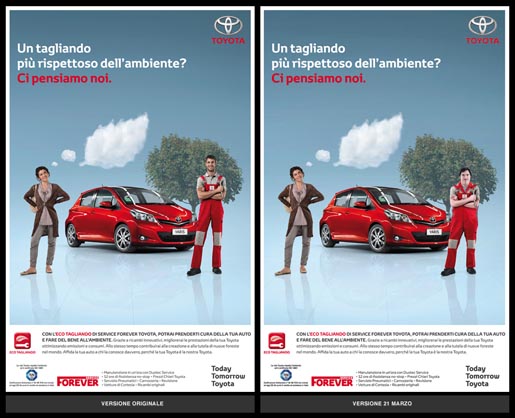
The same happened with print campaigns (by Enel, Carrefour, Toyota) scheduled on the main national Italian newspapers.
And in the same vein, on the 21st of March, people with Down Syndrome appeared in some of the most famous Italian television programmes, replacing the usual stars.
The operation attracted the attention of all the national media, including tv, newspapers, magazines, radios, social media and blogs and, on the following days it opened a debate all around the country.
We generated the equivalent of nearly 5 ½ Million euros worth of coverage and we reached around 18 million people, a third of the italian population. And, most important of all, in the week following the communication event, enquiries to CoorDown from companies interested in integrating people with Downs Syndrome into their organizations went up 600%.
“We are proud of taking part in such an innovative communication event, because we firmly believe in it – declared Sergio Silvestre, CoorDown National Coordinator. We are thankful to Saatchi & Saatchi and to all the other partners for the precious help and the sensitiveness they showed. Regarding the theme of inclusion, unfortunately there is still a lot to do, especially in workplaces and schools, starting from people’s prejudices. The winning idea is sending normality as a message. People with Down syndrome have the right to express their capability and to have the same opportunity as anybody else. But too often they are considered different and incapable of having an independent lifestyle. This campaign is an exceptional example, and we hope it will be the example to follow, every day.”
Advertising Agency: Saatchi & Saatchi, Italy
Executive Creative Director: Agostino Toscana
Creative Directors: Agostino Toscana, Alessandro Orlandi, Luca Lorenzini, Luca Pannese
Art Director: Luca Pannese
Copywriter: Luca Lorenzini
Supporting Creative Team: Antonio Gigliotti, Micaela Trani, Nico Marchesi, Riccardo Catagnano, Davide Vismara, Sonia Cosentino, Anselmo Tumpic, Elena Cicala, Fabio D’alessandro, Manuel Musilli, Antonio Di Battista, Tommaso Zago, Eliana Frosali, Antonio Tardio, Daniele Barone, Emanuele Quadri, Giulio Frittaion, Marco Dispenza, Massimo Paternoster, Alberta Schiatti, Raffaele Bellezza
Production Company: Akita, Made, Mercurio, Catsound, Sing Sing, Networks, Castadiva Pictures, Myavalon, Band, Top Digital, Disc 2 Disc, Flippermusic
Directors: Luca Maroni, Bosi e Sironi, Nadia De Paoli, Xavier Mairesse, Jose Pratt, Leone Pompucci,
Photographers: Davide Bodini, Mecanique Generale, Matteo Cremonini, Platinum, Boudwjin Smit, Lorenzo Scolari,
Post Production: Balalò, Rebelicon, Matteo Tranchellini
Year: 2012

 This is not ADVERTISING